
How I got 30 beta readers for my debut self-published novel
A deep dive on how I recruited and ran a 30-person beta reader team with a 70% manuscript completion rate for my steamy psychological thriller.

Since I’ve been alluding to my beta reader team for my upcoming self-pub debut You’re Overthinking This and sharing screenshots of them screaming…

… authors have been asking what platform I used to collect feedback. The answer is StoryOrigin, and today I’m sharing a deep-dive on how I recruited my team of 30 beta readers, gathered their feedback in StoryOrigin, and synthesized it to make this story shine.
A caveat before we begin: While this ended up being my absolute favorite part of my publishing journey so far, I don’t want any authors to feel pressure to do this, and I’m not saying you should. You might even think getting 30 beta readers is overkill, and that’s okay—to each their own. I’m just sharing my process in case it’s helpful or inspiring in any way.
Since my full writeup is too long for one Substack post, this will be split in three parts:
Revealing my process (this post) - for all subscribers/viewers
Sharing my assets (application, critique guidance, and emails) - for VIP subscribers
A review of StoryOrigin’s Beta Copies tool - for all subscribers/viewers
Why I wanted a big beta reader team
Before I ever got published, I got beta readers for my first three manuscripts—the third of which became All Your Twisted Secrets. Back then, I used the terms beta readers and critical partners (CPs) interchangeably—they were fellow authors I’d swap manuscripts with to exchange feedback. (Was that wrong? Have the terms evolved? Don’t know!)
After debuting, I sold my next three books on proposal and had tight deadlines to draft, with no extra time to recruit betas, wait for feedback, and reciprocate on top of my heavy workload. While my editor (and sometimes editorial assistant) provided excellent input, we’d miss things! Later, I’d see reader reviews criticizing a character’s decision or a cheesy line, and I’d facepalm so hard because I agreed and it would have been so easy to fix if I’d gotten that feedback sooner… but it was too late. Some authors’ ARCs get printed pre-copyedits, but that’s never been the case for me.
Because of this, I always wished publishers had focus groups or test audiences to get readers’ reactions to a book pre-ARCs. But that’s just… not a thing. (That I’m aware of.)
Now that I’m self-publishing for the first time with my newest book—You’re Overthinking This, a steamy psychological thriller—I’m in control of my publishing schedule. Now, I could make time for a test audience. I wanted at least 20 readers so if enough independently commented on the same issue, I’d know it needed fixing. I was also worried only a small percentage would reach the end—a combination of impostor syndrome and the fact that these are volunteers—so I wanted to recruit enough to account for that.
(Note that I’ve also heard of some indie authors getting 70+ or even hundreds of beta readers, but I think my brain would simply implode. 30 was a sweet spot for me!)
Why I used StoryOrigin to collect feedback
When I first set out to build a team of betas, I was overwhelmed. Sending my shiny new manuscript as a Word doc or PDF to 20+ people seemed daunting and unsecure. Some authors recommended I use Google docs and disable downloading/copying, but I worried that (1) if all readers had access to the same doc, they’d bias each other or debates would break out in the comments, or (2) if everyone had their own doc, organizing, naming, and collating feedback would be a nightmare.
Then I learned about StoryOrigin in the Discord Indie Authors Ascending (thanks, Ariel!).
StoryOrigin is similar to BookFunnel in that it lets you distribute ARCs and reader magnets (among other features), but it also has a unique tool for collecting beta reader feedback. You can see its features here, but here’s what convinced me to use it:
Secure manuscript sharing. Readers can’t download it or even access all of it at once.
Ensure participation. Readers must leave feedback on each chapter to unlock the next one. They don’t just get a free read; they have to earn it!
Get detailed feedback. In addition to overall chapter feedback, readers can highlight text to leave in-line comments, and you can mark the status of each.
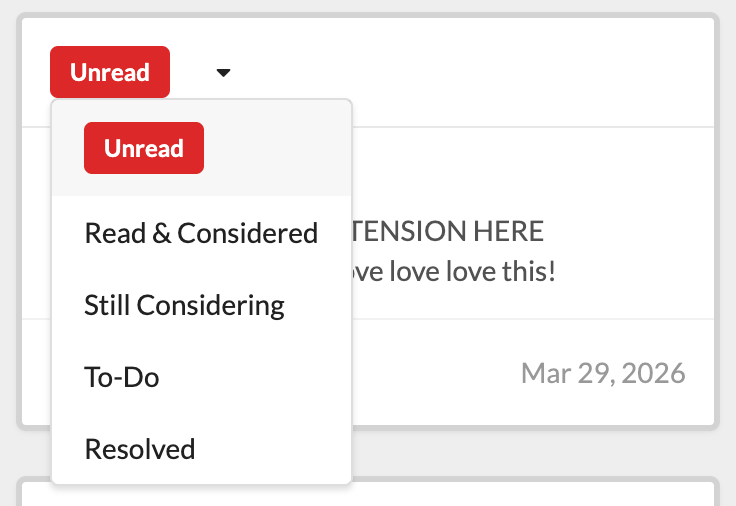
Iterate on the fly. You can see readers’ feedback as they progress through the manuscript, not just when they finish. Concurrently, you can upload new versions of each chapter. New readers to that chapter will see the newest version automatically, and your fastest readers can go back to look at your updates if they’d like.
Limit (or extend) access. Set an expiration date to revoke access at your deadline and/or offer extensions (or revoke access) for each individual reader.
While not a perfect tool (I’ll share more in Part 3), StoryOrigin made this process far less overwhelming than it could’ve been and helped create a fun and unique experience for my team. And I love that for all of us!
How I set up my beta reader team
Note that my approach is a bit more complex than necessary. For example, you can use StoryOrigin for your entire application process (though you only get one text box) and you don’t need to require readers to sign an NDA. Again, just sharing what I did in case it helps!
(And I’ll share the copy I used for each of these in Part 2.)
1. Created a Google form application
Rather than hosting my application in StoryOrigin, I used Google Forms for more field customization, to ask multiple questions, to track invites for each wave of readers, and to email my betas using my own email service provider (ESP) whenever I wanted.
I’ll share all the questions I asked in Part 2, but the most important question that let me qualify readers was: “Why do you want to beta read You’re Overthinking This?” If anyone left this blank or clearly (and I mean clearly) used ChatGPT to fill this out, they did not receive an invitation.
2. Created an NDA
I chose to have my beta readers sign an NDA for a few reasons:
It reduces the risk of piracy, anyone feeding my manuscript to the Machines, or anyone sharing excerpts from this early version of the manuscript.
It weeds out anyone who’s not enthusiastic or committed enough to sign.
It makes it clear this is a volunteer opportunity.
My NDA was extremely basic, and I created a simple Google form to collect electronic signatures. Out of all my applicants, only one said they’d be unwilling to sign. (I’ll make sure they get an ARC!)
3. Added the manuscript to StoryOrigin
This process is fairly straightforward, but in order for StoryOrigin to break out chapters into different sections readers will need to unlock in one easy upload, you need to use Header 1 (H1) tags in Word for each of your chapter headers.
After uploading, you can customize all the basic info for your project—tags (genres), blurb, etc.—but two fields are especially important: application message and critique guidance.
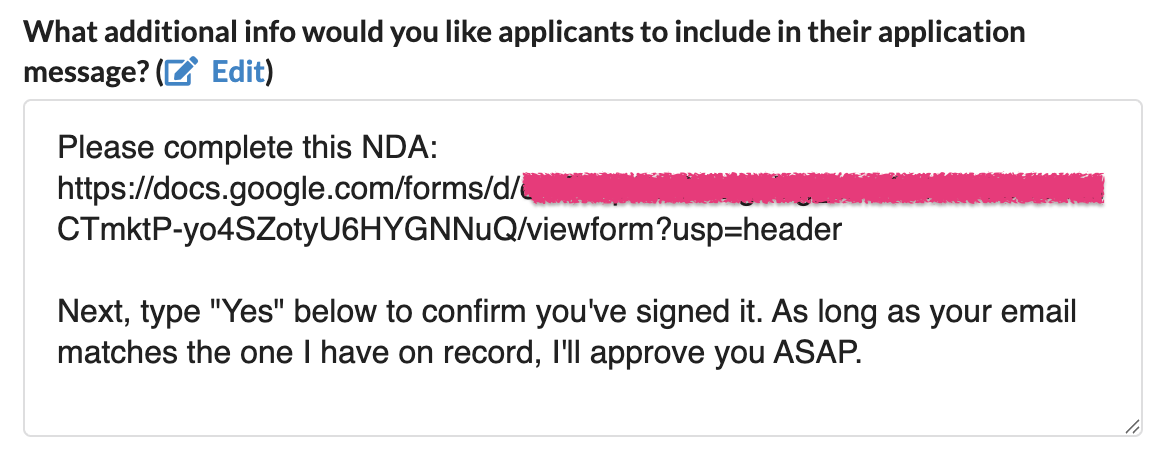
In my application message, I linked to my NDA and instructed readers to simply enter “Yes” in the box once they signed. This is how they request access to the manuscript once you give them the link and they create a StoryOrigin account.
In my critique guidance, I entered the same guidelines I shared in my welcome email. Whatever you enter here will appear at the bottom of every chapter to remind readers what kind of feedback you’re looking for.
I also created a questionnaire at the end of the manuscript with a few wrap-up questions. I did not ask specific questions on individual chapters nor sprinkle questionnaires throughout the manuscript (between chapters), but you could if you’d like.
4. Created a welcome email
Next, in my ESP, I created an email to send to my list of approved beta readers. In this email, I:
Congratulated them for being selected (woohoo!)
Linked to the manuscript in StoryOrigin
Provided instructions for joining StoryOrigin
Linked to the NDA
Provided instructions for requesting the manuscript after signing
Gave a clear bolded deadline
Shared my critique guidance, which outlined my expectations along with a list of seven questions to keep in mind as betas read the manuscript (this is what I copy/pasted in the critique guidance box in Story Origin)
Expressed my heartfelt gratitude for their time
I’ve shared this email and my critique guidance in Part 2.
5. Created a private Discord channel for betas
In my Discord server, Diana Urban’s Thrill Seekers, I created (1) a private channel #beta-readers and (2) the role “Beta Reader” to grant that role access to this channel. Then I spun up a custom invitation link that would assign this role to anyone who used it.
I shared this link with betas (1) in the closing questionnaire in StoryOrigin and (2) via email about two weeks after granting wave #1 access to the manuscript. I didn’t want them to influence each other’s opinions while reading, and we were careful to use spoiler tags until the deadline.
(If you enjoy my books and would like to join my Discord, subscribe to my reader newsletter to get an invitation link!)
How I recruited beta readers
My process for recruiting betas was very agile, which might make this section a bit confusing. Rather than waiting for all my betas to finish to make edits, I kept pace with my fastest betas and uploaded new versions of each chapter to StoryOrigin. This way, slower betas would read V2, and I could get their reactions and confirm my changes worked. (Some betas kept apologizing to me for being slow and I was like NO THIS IS PERFECT!!)
I wound up inviting three waves of betas within a 4-week span (for a total of 30 readers). It was a lot to manage, but this agile process saved me months of time.
Okay, so here’s how I recruited folks. (Keep in mind that I’ve been publishing since 2020, so I’m fortunate to have a readership that made it easier to recruit folks. YMMV.)
Volunteering to beta read is a big commitment, so I wanted to only (1) attract applicants dedicated enough to reach the end of the manuscript, and (2) reward my superfans who’d be HYPED to read and be part of this story’s journey. Providing feedback without compensation is a big ask, so I wanted to make sure whoever volunteered was really into it and would have fun.
As such, I was extremely deliberate with my recruitment posts; I wasn’t going for volume, but quality enthusiasm. I didn’t even call for betas in a dedicated email on Substack or my reader newsletter. (I know this made some folks feel like they missed out, and I’M SO SORRY, but don’t worry—I’ll be running a huge ARC team, so stay tuned!)
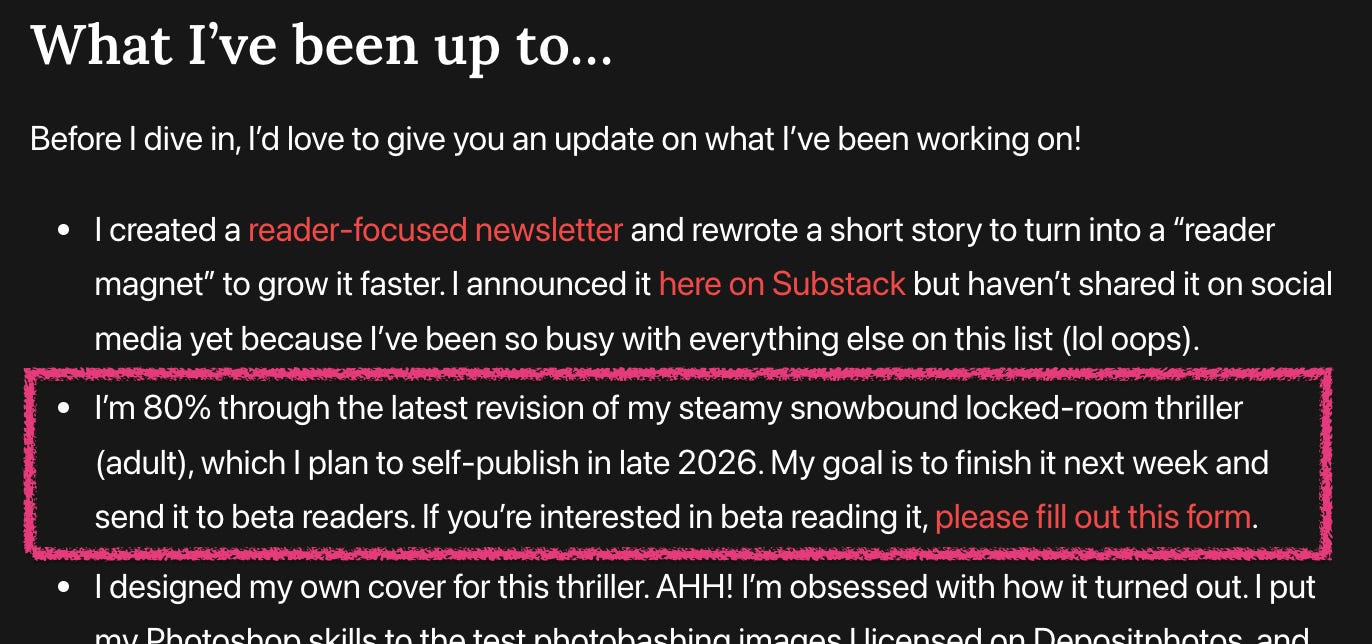
First, I posted about it here on Substack as a single bullet point in this post. 50% of wave #1 applicants came from this.
Next, I posted a call for betas to my Instagram stories asking anyone interested to DM me, and I DMed back a link to a Google form. After about an hour, I had enough applicants, so I deleted the story. (I didn’t save it, so I don’t have a screenshot to share—sorry!)
After I sent out invitations, betas started tearing through the manuscript. I made edits to the early chapters based on their feedback and uploaded new versions to StoryOrigin, but since that first wave of readers was so enthusiastic, most got through the beginning fast. I wanted more fresh eyes on my changes, so I did another call for betas on Threads and replied to anyone interested with a link to the form.
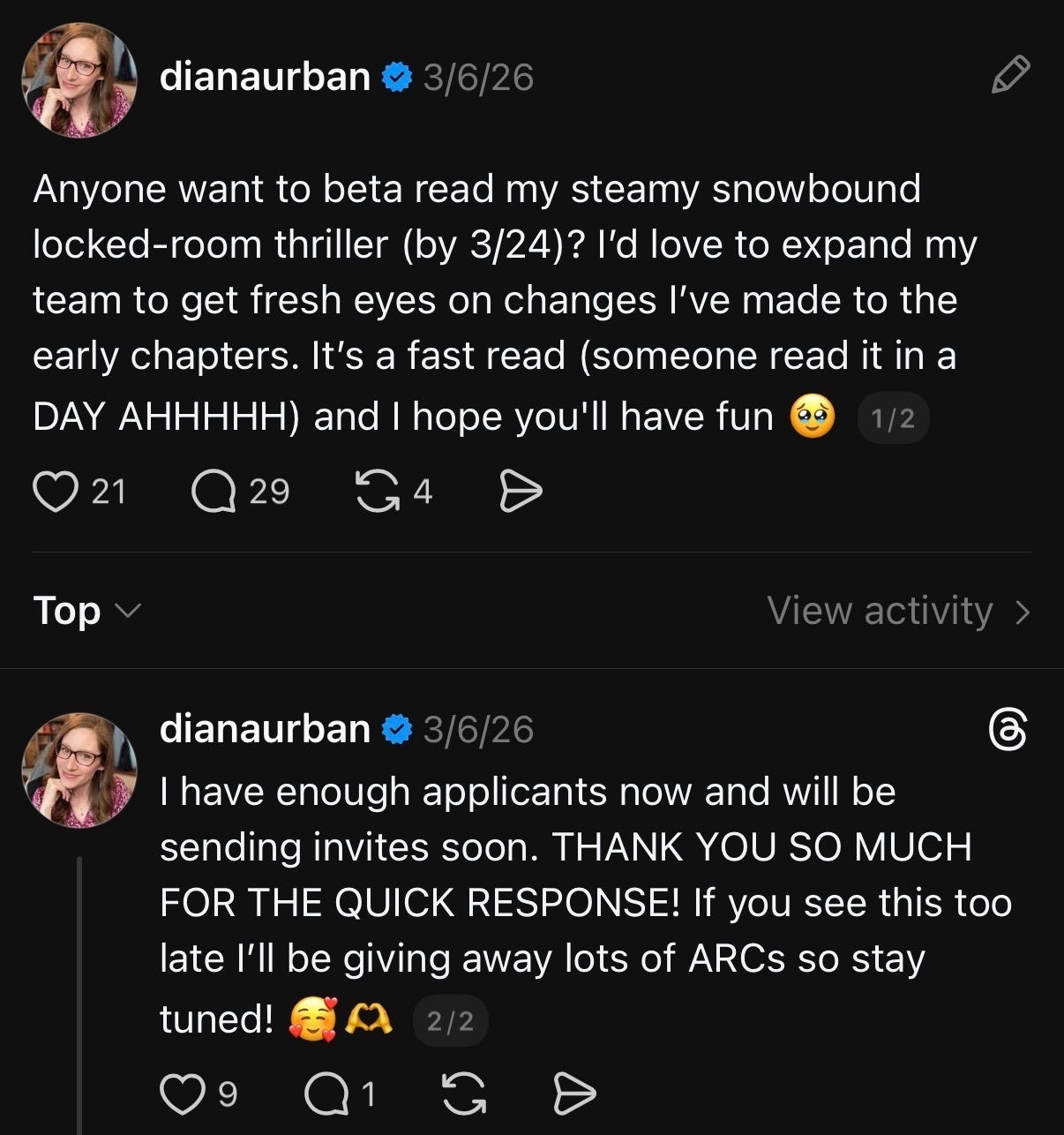
After inviting my wave #2 betas, I intended to keep up with my wave #1 betas so wave #2 would always be reading updated chapters.
Then my cat died.
So. Yeah. I was a useless, sobbing mess for a week.
After I finally jumped back into edits 9-10 days later, I recruited wave #3 betas to get fresh eyes on the middle chapters, since I hadn’t kept ahead of most of wave #2. That time, I posted to Instagram stories and Threads at once, and deleted those posts after a couple of hours. (So no screenshots, sorry!)
How I synthesized beta feedback
Thanks to my critique guidance—plus, I think, because I’m so casual with readers in my Discord, on Threads, etc., with lots of AHHHHHs and general silliness 🤪—I invited some incredibly blunt feedback. And that’s exactly what I wanted. I wanted my betas to be ruthless with me so I could improve the work and avoid as much public evisceration (on Goodreads, TikTok, etc.) as possible.
(Though, who am I kidding? It’s a psychological thriller, and it’s got polarizing twists. There’s really no avoiding it lmao.)
I won’t say their feedback was always easy to take. With four published novels under my belt, I have a weird mix of impostor syndrome and thick skin. But for the most part, it felt like I had 30 buddies sitting with me as I made edits, laughing with me, screaming with me—sometimes at me—and encouraging me to make this the best story I could. Some folks even read it twice. Others read specific chapters multiple times when I pinged the group about updates I made via email and on Discord (about two-thirds of betas joined the private channel).
If I had to guesstimate, I’d say I took action on about ~75% of readers’ critical notes in StoryOrigin, not including times they pointed out typos, missing words, awkward phrasing, etc.—those I fixed 100% of the time.
Sometimes I felt bullish about wanting to keep something as-is, but once a third reader critiqued the thing, I considered that a consensus and conceded. This is one reason StoryOrigin is great for keeping everyone in separate silos, and why I didn’t hand out that Discord invite link until later. Getting the same critiques independently was invaluable.
I didn’t always take readers suggestions on how to fix something, just like I wouldn’t if it were my editor at a publishing house. Instead, I looked for the root cause of the critique, and often found a different way to address it.
There were plenty of contradictory comments, too. I’d giggle every time one person highlighted a sentence and called it “beautiful” while another called the same exact sentence “cringey.” It was a reminder that the art of storytelling is incredibly subjective.
That’s why I didn’t address ~25% of the critiques. As a people pleaser, this was tough. I had to constantly remind myself that we were 31 different humans with 31 sets of opinions and preferences. You can’t please 100% of your audience 100% of the time. For example, one reader wanted an entirely different whodunnit. Another wanted the FMC and LI to spend 2-3 days together before the inciting incident. But those would be different books altogether. Ultimately, it’s up to me to tell the story I want to tell.
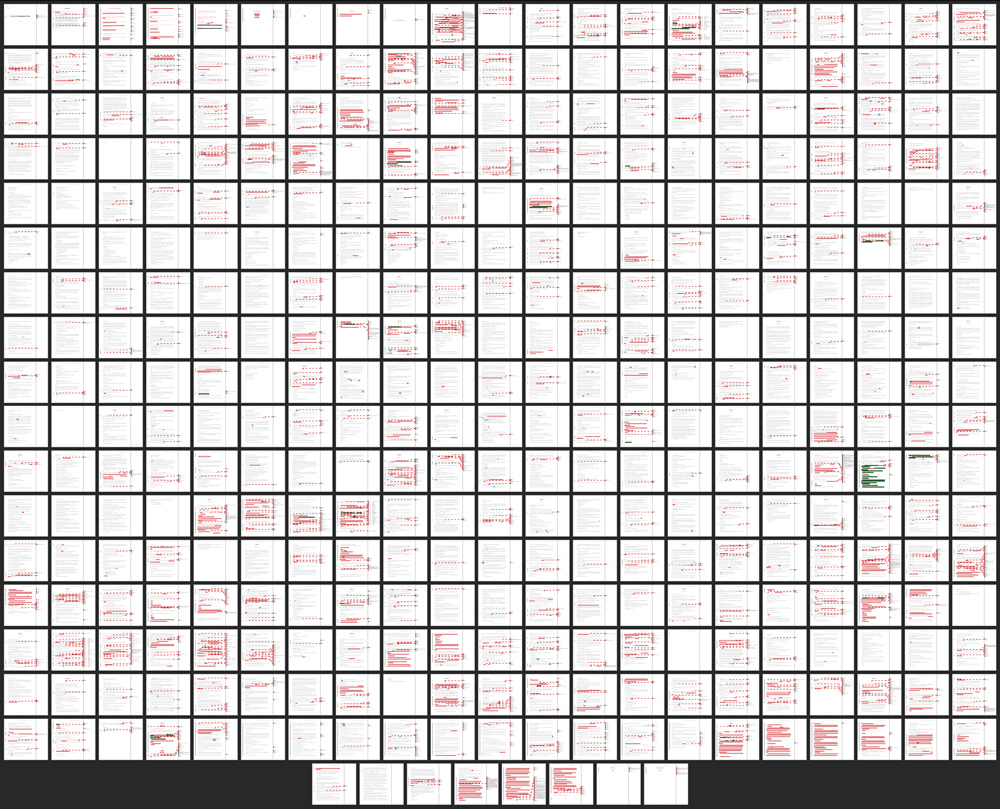
For the changes I did make, it was incredibly gratifying to upload a new version of a chapter and see the next wave of readers pass by with no comment or just compliments. Ahh. Mission complete. Here’s a zoomed out view of the Word doc showing all the edits I made thanks to beta reader feedback.
My beta reader team stats
48 applicants
36 people invited to read
30 betas made meaningful progress (9+ chapters)
21 betas finished the manuscript
Of the six invited who didn’t become betas, two didn’t sign up for StoryOrigin, two did but didn’t open the manuscript at all, and two didn’t make it past chapter two.
Of the nine who made meaningful progress but didn’t finish, there was no consistent dropoff point. Several emailed along the way to let me know life happened, whether they lost a job, started a job, got sick, lost a loved one. As someone who lost their soul fur-baby in the middle of all this, goodness, I related.
Regardless, all 30 of my betas were instrumental in making this story sparkle, and I’m grateful and humbled they took the time out of their busy lives to help me. They’ll all be included in the acknowledgements, be auto-approved for my ARC team, and receive any exclusive bonuses first. They’ll also get a special gift from me closer to launch but IT’S A SURPRISE SO SHHHHHH.
Edit 5/22/23: Since You’re Overthinking This doesn’t launch until November, I still don’t have any sales or ratings data yet to provide quantitative evidence that the manuscript’s quality reflects all this effort. But the audiobook rights did go to auction six months before release, and before I revealed the cover (AHHHHHHHHH!), so that’s an extremely happy result. I’m so, so grateful for my beta team. 😭🫶
What’s next?
Now that I’ve sent this manuscript off to my copyeditor, it’s time to hunker down for a bit to draft my next contracted YA book. Here are quick links for Part 2 (assets) and Part 3 (StoryOrigin review) of this series. I hope this was helpful!

This was fascinating and inspiring.
Love this Diana!! Thank you for sharing!