
You're Overthinking This: My self-publishing journey begins!
Sharing what I’ve done so far IN-DEPTH, from recruiting beta readers to redoing my newsletter and teasing the preorder…


In some ways, 2026 is already flying by, but personally, it’s been so chaotic, it’s hard to believe it’s only mid-March. Let’s sum things up with some bullet points:
January - February: heavily revised You’re Overthinking This, my adult self-publishing debut, a steamy psychological thriller.
January: came up with a new YA thriller idea. Wrote the first three chapters and a bulleted synopsis.
February: SOLD that YA thriller to a new-to-me publisher in an exclusive submission.
February: wrapped up Reedsy client work (I’ll be taking a hiatus to write the YA).
Last week of February: went on a tropical vacation.
Last day of vacation: my husband’s grandmother passed away.
March 3-7: sent You’re Overthinking This to two rounds of beta readers.
March 9: our cat passed away.
March 9 - 14: sobbed, mostly.
March 15: put You’re Overthinking This up for preorder to force myself to stop wallowing.
SO, YEAH.
On top of all that, I promised you I’d share my self-publishing journey here on Substack as I go through the process for the first time with You’re Overthinking This. And since I’m still too mopey to make progress on my fiction work… let’s do this! I hope this helps any authors out there starting their own self-pub journey.
(Sorry if any of this is hard to follow. I miss my cat and my brain is mush.)
Step 1: Revised, revised, revised
My first step was to make this book as strong as I possibly could. I want this book to blow up in a big way (don’t we all??? lmao) and the best way to do that is to create a book readers simply have to tell their friends about.
I hadn’t touched this manuscript since May 2025, and coming back to it after 7-8 months was wildly helpful. I hacksawed my darlings, massively amped up the tension (both the scary and sexual kinds), intensified the twists and added a new one I’m OBSESSED with, and smoothed out FMC’s logic when solving the mystery, which required rewriting key scenes altogether.
As I revised, in parallel I worked on steps 2-6 below.
Step 2: Shored up my newsletter
It’s taken me years to solidify my newsletter strategy because most of my subscribers have been fellow authors, not readers. As a BookBub veteran and now book marketing coach, it’s basically hardwired into my DNA to share everything I know about publishing and book promo at all times. So for years, I mostly spoke to authors about publishing in my newsletters—but they’re not my fiction target audience.
In December 2024, I took the first step to split my mailing list in two—one for readers, one for authors—by moving everyone from my primary email setup (HubSpot/Wordpress1) to my new SubStack. I knew authors comprised at least 90% of my list, so it was easier to export/import everyone here at once.
Then in Dec 2025 - Jan 2026, I rebuilt everything in HubSpot/Wordpress—my forms, landing pages, double opt-in flow, welcome emails, initiation sequence (via automation), and newsletter template. Then I did Step 3 to get the readers back over to HubSpot/Wordpress. No importing/exporting this time—it’s up to readers to self-identify and opt into my reader-focused newsletter.
Step 3: Published a reader magnet
To make it more enticing for folks to sign up to my reader-focused newsletter, I revised a short story I originally published in an anthology but had the rights reverted back to me. I’d give this to readers for free in exchange for subscribing.
To segue into my adult romantic thriller brand, I aged up the characters, made it steamier, and rewrote much of it to improve it in general. Once I was happy with the story, I used Canva to design its cover, used Vellum to format the interior, and set it up on BookFunnel for easy reader magnet delivery. Then I created promotional graphics in Canva and published this Substack newsletter to inform everyone of the great newsletter split, encouraging readers to subscribe here. (If you haven’t yet, I’m reminding you now. How sneaky of me.)
At that point, it was clear I was right about that 90/10 split. But over the next month, the FUN thing was seeing my reader-focused automation emails increase from 20-30% open rates back in 2024 to 50-65% now, not including the welcome email (post double-opt-in), with a 80% open rate. Woohoo!
Step 4: Redesigned my website
Honestly, I spent too much time on this and some of it probably wasn’t necessary, but I enjoy fiddling with my website. Here are some of the key changes:
Updated my branding and design throughout. Aimed for simplicity and consistency, and made all pages mobile-optimized, which was long overdue. Now it’ll be easier to update.
Created a book page for You’re Overthinking This.
Created a short story page for The Last Time I Saw Her Alive.
Updated my Books page with these two new stories.
Created a new newsletter subscription page and confirmation page to improve double opt-in conversion rates.2
Redesigned my “Link in Bio” page (instead of using Linktree).
Created an ARC team signup page that I’ll swap for the official Google form signup sheet later, and I’ll email everyone who’s filled out this form first.
Step 5: Designed my book cover
Over a year ago, I got lucky and found the perfect photo on DepositPhotos for my FMC and MMC. I licensed it immediately, and ever since, I envisioned exactly what I wanted my cover to look like using that photo. I considered hiring a cover designer, but in case you haven’t noticed, I love having control over all the things. I wanted full access to the layered file and permission to tweak it whenever and however I wanted. So I decided to design it myself.
Thanks to my experience with Photoshop, I was able to do so, and the process was so much fun—I can’t wait to show it to you. I’ll have to edit the design once I know the book’s exact dimensions, as I won’t know the spine width until post-copyedits, but I’m THRILLED with how it’s turned out so far.
Step 6: Commissioned a character artist
While I’m familiar enough with Photoshop to photobash and edit stock photos, illustrating characters and graphics from scratch goes way beyond my skillset. Commissioning character art is less common for thrillers than for fantasy and romance, but since You’re Overthinking This is a very romantic and steamy thriller, I wanted character art to help with promo. And since many artists book up months in advance, I wanted to get a head start.
But again, I got lucky. One day, at the top of my Threads feed, an artist had posted that she was opening up to commissions for the first time. I loved her work and reached out via DM, compiled a creative brief (I knew exactly what I wanted the scene to look like), and long story short, I hired her. And she absolutely nailed it. Now I have a marketing asset ready to go, and she’ll also be designing a piece for my upcoming YA thriller. Yay! I can’t wait to share this, too.
Step 7: Recruited beta readers
Once I finished revising You’re Overthinking This, I felt the manuscript was sharp enough to do without a developmental editor; it already went through the wringer with my agent in 2025 and in publishers’ acquisitions meetings, and that was before my big overhaul. Still, I wanted more eyes on this latest revision before sending it to my copyeditor.
In my years of traditional publishing, I always wished I could get a focus group / test audience to read ahead of ARCs. My editors have been great, but they’re just one person—sometimes two, if they had an assistant—and I’d often see reviews consistently call out an issue I absolutely would have fixed if I knew about it when I had the chance.
This is where beta readers come in handy! On the trad side, I always thought of betas and CPs interchangeably—fellow authors I’d swap manuscripts with to provide each other edit letters and markup in a Word doc. As I got deeper into trad pub, I no longer had the time (deadline-wise) or bandwidth (to swap manuscripts) to involve CPs/betas any more.
But on the indie side, beta reader teams are often exactly like those test audiences I always craved, and now I’m in control of my own deadlines. YAY! Every author is different, of course, and has different expectations of their betas, but I’ve asked mine to be like a test audience and react to things without providing in-depth editorial assessments, which seems like a common approach.
Ultimately, I recruited a team of 25 readers and gave them about three weeks to read.3 Everyone’s going at their own pace, and it’s been a joy to see them finish the book (one reader read in 24 hours, another in 48, which wildly impressed me—I’m such a slow reader myself!), and their feedback has already been so helpful. They still have over a week to finish, and then I’ll do one more round of revisions before sending it to my copyeditor.
Step 8: Bartered for a copyeditor
I fully intended to hire one, but one day I hopped on Threads and asked if any experienced copyeditors who are also authors would be willing to barter for the marketing services I provide on Reedsy. Two minutes later, I had several responses, and I’m so excited about who I’ll be bartering with! I’ll send her my manuscript in April, and while she edits, I’ll build her marketing plan. It’s a win win win!
Full transparency, again, I got lucky here. I cannot emphasize enough how much of publishing—both on the trad and indie side—hinges on luck. In this case it was a combination of algorithmic luck and my background in book marketing, but still. LUCK HELPED.
Step 9: Created announcement and teaser graphics
Now that the cover’s pretty much ready to go, I used BookBrush and Canva to create a placeholder cover to use on Amazon, my website, and early promotional graphics.

Here’s an example promotional graphic—you can see the whole carousel on Instagram.

I have more ready to go, and here I should note how helpful upgrading to Canva Pro has been. As a Photoshop girlie, I resisted for a long time, but now I have my Brand Kit set up with my frequently used fonts and colors, easy-to-use editing features, and access to loads of stock vectors, images, and videos. You need to be careful if you want to avoid AI—it’s getting real hard to tell the difference—so for the stock photos I plan to use regularly (like this one above with the deer), I’m still licensing them through DepositPhotos.
Step 10: Put the book up for preorder
Once a few beta readers finished the book and were all-caps screaming at me how much they loved it, I mustered enough confidence to finally pick a release date so I could put the book up on Amazon for preorder.
But then my cat decided to become an ex-cat. To be no more. To cease to be.
I’m diffusing this with Monty Python humor when I’m actually a devastated wreck; last week was the hardest week of my life. So I put off the preorder until yesterday, when my tear ducts simply ran out of liquid and I decided it’s time for life to keep lifing.
It was a nice distraction to do the work I usually do for clients for my own book—the metadata research to find the right categories and keywords, optimizing the subtitle, and so forth. I set the publication date for November 19th for a few reasons:
It’s a snowbound thriller, so launching it before winter for heavy promotion over the holidays and snowy season in the US and Canada seems like perfect timing.
Thursday because of the responses I got to this Thread—most indie authors seem to prefer publishing on Thursday or Friday as to not conflict with trad releases on Tuesdays and to be closer to payday, so let’s put that to the test!
It’s probably further out than I need it to be, but will give me enough buffer for all the promotions I want to prepare while also on deadline for my next YA thriller (with a deadline of September 1 for the first draft).
It’s four days after my birthday and I figure it’ll be a fun way to celebrate!
Step 11: Screamed about the preorder
When I submitted the book on Amazon, the confirmation message made me think I had three days before I’d make any announcements.
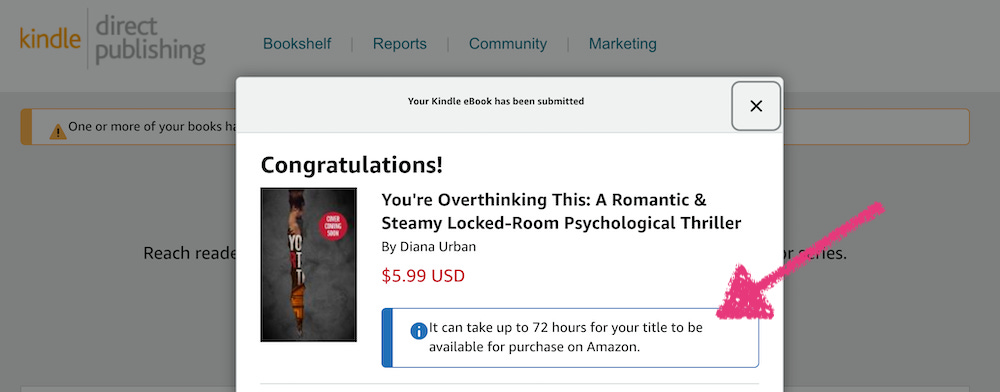
Friends, it did not take 72 hours. It took one hour. And then there it was—my first self-published book, up for preorder on Amazon. Naturally, because I’m an extremely silly person who can’t keep a secret to save my life, I immediately screamed about it on Threads.
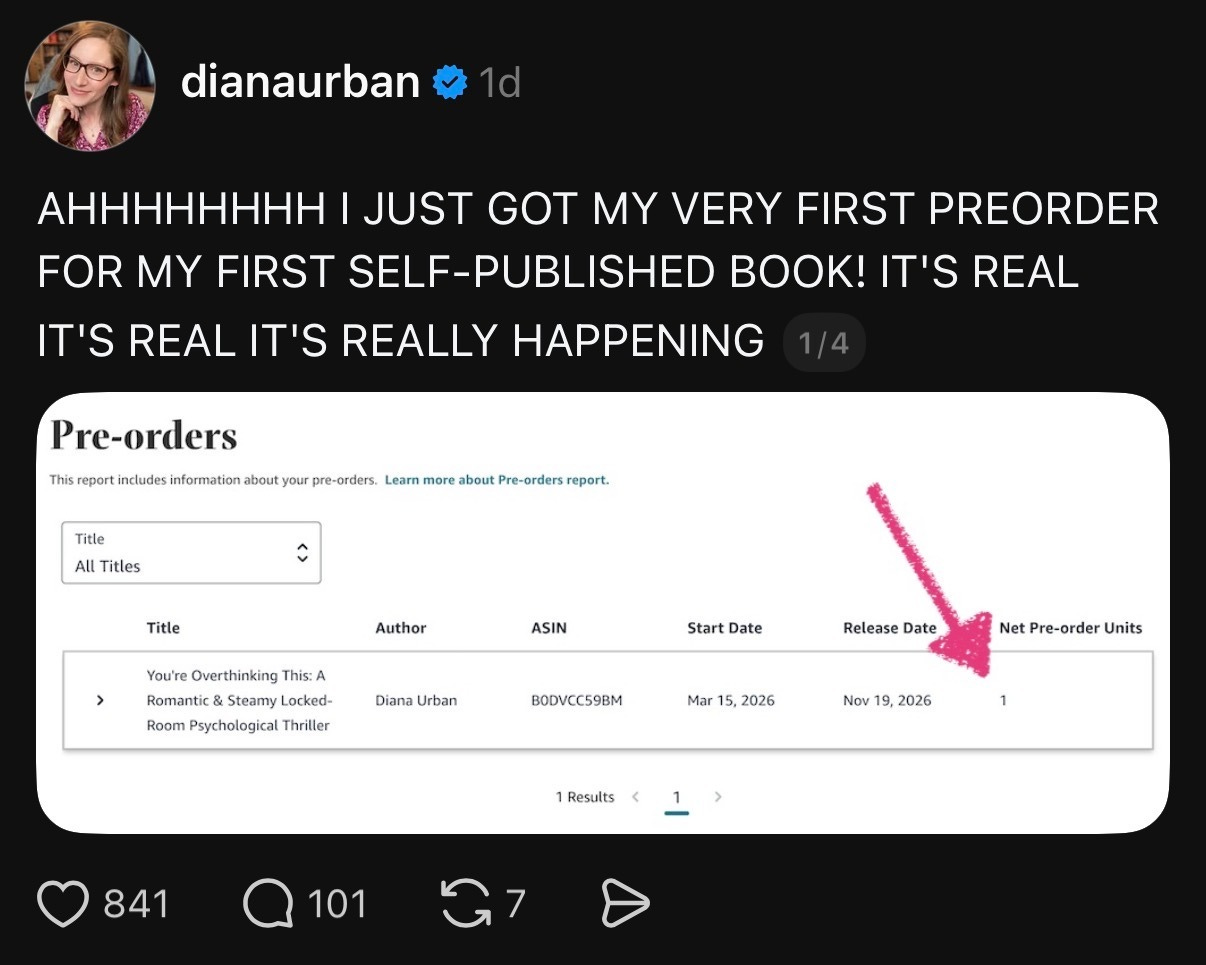
It’s way too early to tell anything, but so far, this all-caps, off-the-cuff post vastly outperformed my carefully curated announcements earlier today, which included an email to my reader list, an Instagram post, and a Threads post. A WIN FOR CHAOS!
Step who even knows?
Honestly, there’s even more I haven’t included above that exist simply from being in this game for 10+ years now. Like my Discord community, which has been more active so far this year (yay!), and this Substack, which yes, is primarily for authors, but I’ve absolutely plugged You’re Overthinking This here and several of my beta readers came directly from here. It would take a book in itself to include everything I’m doing all the time, but I hope pulling out these highlights will help anyone else starting on their own self-publishing journey.
Some thoughts on moving forward
Now that I’ve built my foundation, most of my plan revolves around having fun and genuinely connecting with readers. That’s what it’s all about. I plan to send as many ARCs as I possibly can, invite readers to my mailing list (where my emails are now more personal) and Discord (where we can squee together), and be my chaotic self on Threads.
One thing about me that has to change: I can’t be a perfectionist anymore, especially when it comes to promo Between writing an entire book on contract by September and prepping another for self-pub in November, I must be expedient. I even time-boxed this post; I started writing it on 3/16 at 12:30pm with a goal of getting it out by EOD, and somehow, I’ve managed it. It shows in its wordiness, but good enough will have to be good enough.
Lastly, I’m STILL burned out from all the video marketing I did in 2024 to promote my last book, Under the Surface, for which I went viral many times and didn’t get commensurate sales. I’m considering hiring someone to produce ~20 videos using the cover, graphics, and b-roll I’ll provide, because I physically can’t bring myself to open CapCut. If you have any recommendations, please let me know.
In summary, AHHHHHHHHHHHHHHHHH—in excitement, overwhelm, devastation, and everything in between. No matter what the rest of this chaotic, roller coaster of a year will bring, I’m so glad you’re along for the ride with me.

I use HubSpot as my email service provider because I used to work there so have a free account. If I didn’t, I would have chosen Flodesk.
I’ll also cover this in detail in a later post. Please don’t sign up just to see my flow, that’s what I’m trying to get away from lol but I promise I will share!!
I’ll also cover this in detail in a later post! It’s been such a fun process, I can’t wait to tell you more.
What a fantastic post—and yay about your first indie! However, I am so, so sorry about your kitty. ❤️
I can’t tell you how excited I am to read this! I currently have a psychological thriller on sub (2 weeks today). If it doesn’t sell, I also may consider self-publishing it. My debut was traditionally published, so been there, done that.