
How I relaunched my book as a #1 New Release (trad to self pub!)
After getting the rights back from my publisher, I self-published my book on Amazon as a #1 New Release. Here's how I did it!


In my last post, I shared how I got the rights back to my book, These Deadly Games. In this one, I’ll cover what came after: repackaging it as a self-published book and launching it on Amazon to be a #1 New Release within 24 hours.
Before I dive in, I want to be clear about my goals for this relaunch:
Make it available to my readers who were asking for it. Now it’s in print again!
Have it ready to go when my new trad-pub YAs come out to drive read-throughs.
Use it as a testing ground for ads, print formatting, library distribution, etc. (Basically a practice run before publishing You’re Overthinking This in November.)
This was not meant to be a splashy release. I ran no preorder campaign, no ARC team, no big rerelease campaign. I don’t plan to create many Reels or Tiktoks for it in the immediate future. Two main reasons:
YA contemporary is notoriously tricky to self-pub successfully. Take the pricing alone: YA paperbacks are usually priced lower; my debut is $10.99. If I offer this book at $10.99 with the recommended 55% wholesale discount for retailers, I’ll LOSE $1.66 per copy. Plus, most teens don’t have their own Amazon account. Other YA genres have more crossover potential with adult audiences, demand for splashy special editions that could drive up the price, etc.
I have bigger priorities. I’m on contract for a new YA thriller and I’m self-publishing You’re Overthinking This in a few months. My brain hurts.
Your goals may be a heck of a lot different from my goals, especially if you got the rights back to a book in a more viable self-pub market. But I hope sharing the steps I took to repackage everything will be helpful no matter your goals. Let’s go!
1. Did a huge revision
I don’t know how often authors do big edits before a relaunch. I think they usually reformat it and make a few small tweaks? Maybe? Which is great! But not my path. My path is to do everything the hard way. I’m a monster.
The whole premise of These Deadly Games is that the protagonist, Crystal, gets a message from an anonymous kidnapper with a video of her sister taken hostage, bound to a chair. The kidnapper forces Crystal to play a twisted game that leads to her sabotaging—and killing—her friends one by one. If she refuses, they’ll kill her sister.
When I wrote this book in 2020-2021, this premise flew.
In 2026, Crystal would instantly suspect that video’s AI. INSTANTLY. The emergence of this tech changes everything about how she’d react, her theories along the way. For the premise to be believable, she’d now need to see specific evidence in the videos to convince her they’re real.
To be clear, I’d never expect all YA books to get updated for changing tech. Can you imagine? Cell phones! The internet! Smartphones! Social media! Facebook > Instagram > Snapchat > TikTok > Whatever The Fuck’s Next! THERE’S NO WAY!
But in this book, it affects the entire premise. Reviews were starting to complain about how Crystal should think of AI. It bothered me, too. I wished I’d published it just a couple of years later so I could have taken our new reality into account. So when I got that chance, I took it.
While I was in there, I figured: might as well revise the whole ding dong thing. I’ve honed my craft so much over the past 5-6 years, so why not? I changed the tense from past to present to increase the urgency. I tightened the pacing, cutting 6k words (from 96k to 90k). I improved the prose and dialogue throughout. And I’m so proud of how it’s turned out. Pooped, but proud.
2. Got a new cover
When you get the rights back, you don’t get to keep your existing cover, and I wanted a refresh anyway. The initial cover was cool—I always loved the silhouettes—but it didn’t hit that “Ooh I need this book because it’s stunning” note. Also, sales weren’t great to begin with, so I wanted to try something different.
First, I hired an illustrator I’d worked with before, Lauren @cinderlight.art (on Instagram), who gorgeously rendered the protagonist with an homage to the original silhouettes.

Next, in Photoshop I added the text (I licensed) and blood splatters (one of the brush defaults), and designed it to pair well with my debut, All Your Twisted Secrets.
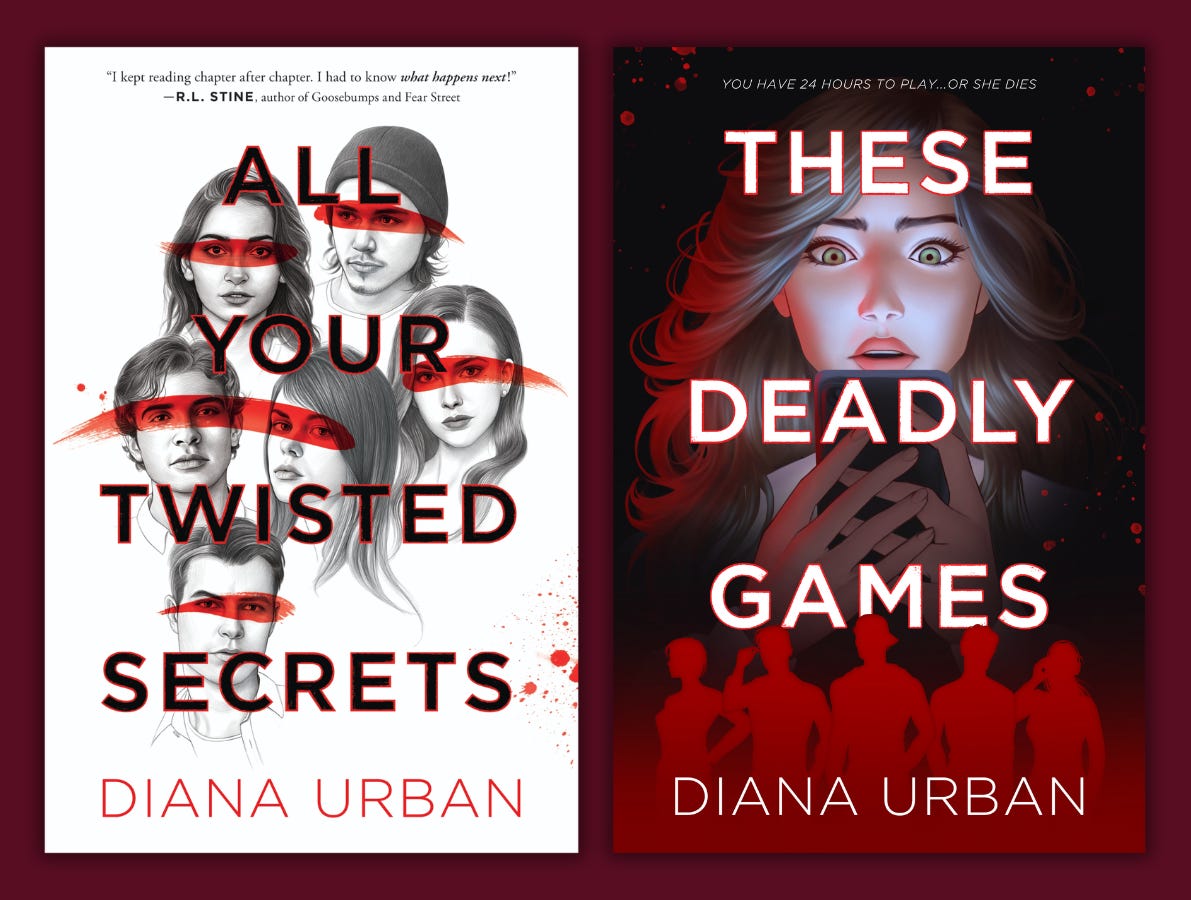
I should also note: I considered changing the title because “These Deadly Games” didn’t perform well, and it wasn’t my intended title. But because this book made it onto lots of school book lists, including YALSA’s Quick Picks for Reluctant Young Adult Readers, I decided to keep it as-is. TBH I’m still not sure this was the right call.
3. Created bonus content
One of the best ways to grow your mailing list is by adding a reader magnet at the end of your book offering bonus content in exchange for an email signup. Some authors give away a bonus epilogue, deleted scene, or short story. I chose a smorgasbord of bonuses. At the end of These Deadly Games, there’s a link and QR code leading to this page:
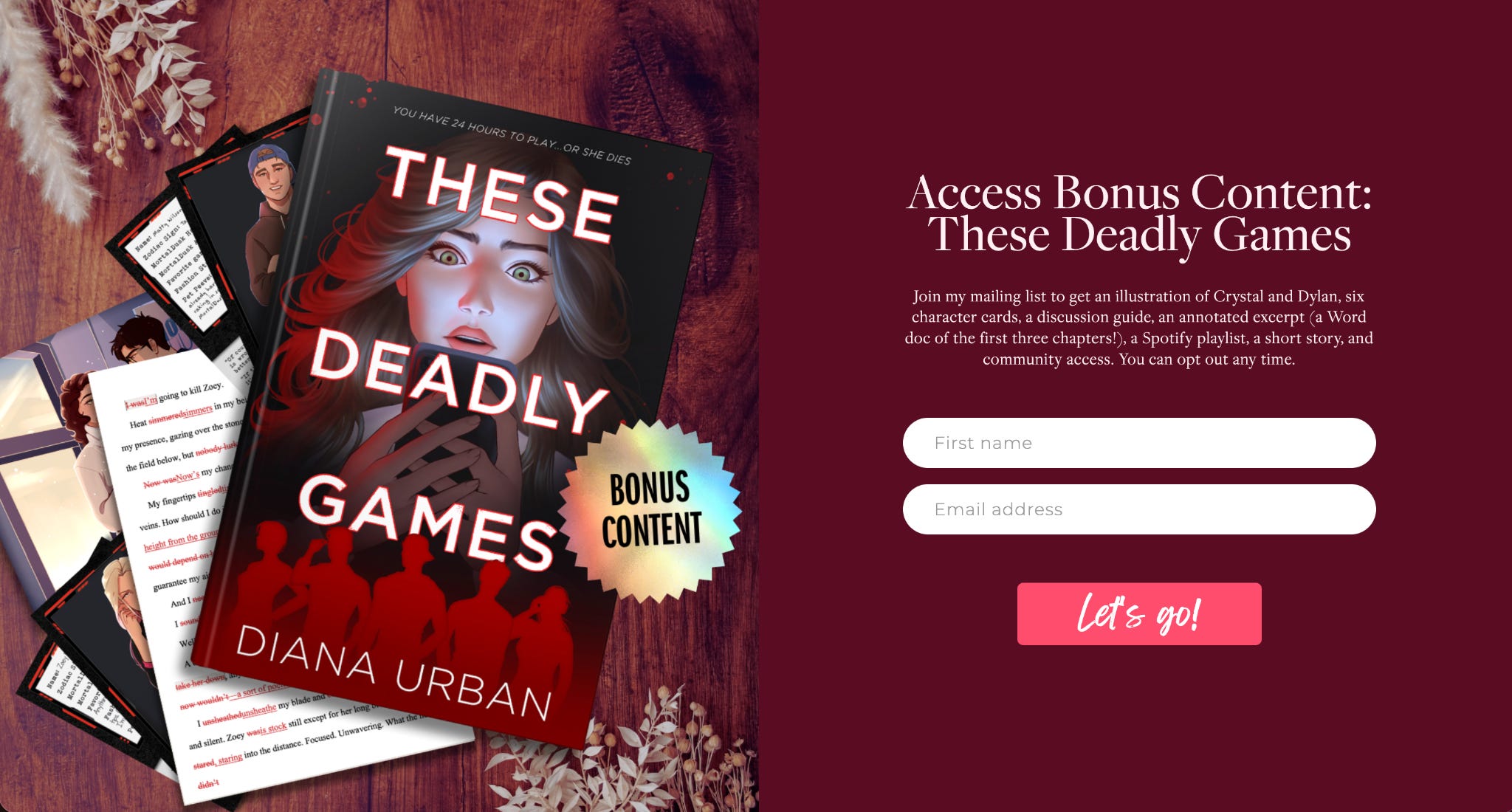
The confirmation email has a link to a password-protected page on my site where they can download:
Illustration of Crystal and Dylan
Six character cards (with bonus content on the back of each)
Discussion guide
Annotated excerpt (download the first 3 chapters as a Word doc and see my track changes and in-line comments!)
Spotify playlist
They’ll also get the short story I give to anyone who joins my mailing list and an invitation to my Discord server and Facebook group
Thankfully, I already had most of this content from when the book first came out, with artwork from Mars Lauderbaugh. The annotated excerpt is new, but it was fun to write up those comments. Authors, I think you’d be particularly interested in the Word doc; I share lots of craft tips I learned in the past 5-6 years!
4. Formatted the book
I used Vellum to format the book, and it makes it SO EASY, especially when you’re not giving a book all the extra bells and whistles. I may consider an edition with sprayed edges when my workload gets a bit more manageable. But for now, I’m thrilled to give this book a paperback when it never had one before, and I’m grateful Vellum made it possible to complete this task in like an hour.
5. Did a metadata refresh
This book never ranked well on Amazon, so I started from scratch except for the description, which I revised, adding a short, punchy logline to the top and a new closing hook to add comps, vibes readers can expect, and tropes. Read it here.
I used Publisher Rocket to choose my subheader keywords, three categories, and seven keywords. This tool takes so much guesswork out, surfacing keywords high searches and low competition. It also reminds you what keywords not to use (like those with “book”, “kindle unlimited”, or “new”) so you don’t waste any of those seven precious spaces with terms Amazon will disregard.

For categories, I chose two broad and one niche that’s easier to rank for. If you get a “#1 New Release” or orange “Bestseller” banner in a niche category, it’s visible on the book’s listing everywhere on Amazon, which is great social proof. My publishers usually only assign my book to broad categories,1 so I’ve rarely gotten to post those YAY ORANGE BANNER screenshots to social media.
6. Designed Amazon A+ content
For midlist titles at traditional publishers, it’s common to just paste a blurb or tagline into each graphic. But this space offers a great opportunity to provide more of a visual hook into the book than you can with the description alone. I wanted a refresh, so off to Canva I went.

7. Uploaded the ebook to Amazon
This part made me nervous because I tend to get hyper when pushing buttons and miss little details that make everything go wrong. But here’s how this process went:
Created a brand new book listing on Amazon KDP.
Four hours later, I got an email from KDP: “During our review, we found that your book contains interior and/or cover content that's available from a different publisher. We need you to confirm your publishing rights before the book is made available on Amazon.”
The next morning, once I saw it, I replied with the rights reversion letter attached.
Within an hour, I got a “Congratulations” email that the book would be live in the marketplace soon. A couple of hours later, it went live.
Contacted Amazon support to ask them to merge the reviews with the hardcover listing still live from my publisher.2
About an hour later, the book listings were merged.
It took about 5 days for the listing to appear in Amazon searches for “these deadly games”. Some indie authors prefer not to put their book up for preorder, but this is a good reason to do so, even a short one, to give the algorithm time to “learn” your book and fix any snafus before launch day.
8. Launched at $0.99 just for my mailing lists
I launched the ebook on Amazon at $0.99 (at the 35% royalty rate) on a Wednesday and it remained at that price until the following Monday.
On launch day, I emailed my reader mailing list announcing the new edition. The next day, I posted here on Substack with the story of how I got my rights back. On Sunday, I emailed my reader list again: last chance to grab a copy at $0.99! On Monday, I raised the price to $3.99 (at the 70% royalty rate) where it will stay except for quarterly Countdown Deals or Free Days.
MY MISTAKE: I made the exclusive period too long. I promised a week and ended up doing 5 days because all the orders came in on days 1 and 2. Not being able to shout about the #1 New Release status on social media as it was happening hurt my Amazon rank potential (and was stressful lol). From now on, an exclusive offer that impacts rankings will last for 24 hours. If you want the deal, gotta pay attention!
9. Posted on social media
I decided to spend exactly one week posting about this book on social media. THAT’S IT. If you’re trying to make a big splash with your relaunch, you’ll have a different approach. Here are my Instagram posts in case the inspiration helps:
Monday: relaunch announcement
Tuesday: cover illustrator appreciation post
Wednesday: bonus content reveal
Thursday: my story of how Taylor Swift inspired me to get the rights back
Friday: reasons not to read this book trend (this did the worst; I actually archived it because I want to try it again with a photo of the paperback instead of a Canva-graphics post.3)
Once I get the paperback in the mail and can take photos, I’ll post a few more times when/if I feel like it. But for the most part, I have to focus on writing my contracted book now. Social media is too big a distraction, and I need to take a break until it’s time to heavily promote the ARC signup form for You’re Overthinking This. Which is happening soon. Eep.
10. Experimented with some ads
I ran a Goodreads giveaway (for 100 Kindle copies) to remind folks who’ve added the book over the years that it exists. Goodreads will automatically distribute those ebooks, so easy peasy, and there’s no additional cost for shipping copies.
I also ran 2-3 days worth of BookBub Ads, Amazon Ads, and Meta Ads, just for funsies; no significant results to report. I need to dedicate a solid chunk of time to optimizing my ads before committing to a budget and I just don’t have time right now. Once I do, I’ll share my findings!
11. Started print distribution
This is still in-progress because I’m waiting for my IngramSpark and BookVault proofs, but the paperback is live on Amazon! This part was A LOT so I’ll save it for a separate post, but wanted to mention it here since I did work on it during relaunch week.
Now that These Deadly Games is back out in the world, I’m thrilled I reclaimed my story. Even though I don’t have the time now for the marketing that could make it soar, it’s ready for it. And readers can grab a copy whenever they want. For now, that’s enough.
I hope sharing this helps you navigate the steps to self-publish if you get your rights back. If you find this post valuable, please consider buying a copy of These Deadly Games or subscribing to this Substack. 🫶
One time I asked about it, and a contact at my publisher said “we don’t control that; Amazon adds books to those niche categories automatically.” This surprised me, since as an indie author I can control that. If you work at a publisher, would love your thoughts in the comments.
The support rep asked for the ASIN from the trad ebook and said they couldn’t merge the listings without it. (Which, weird? Shouldn’t they have that record?). My publisher took down the ebook immediately upon sending the reversion letter, and I hadn’t thought to jot down the ASIN. Thankfully I remembered that Goodreads keeps records of each edition and its ISBN and/or ASIN, and that’s where I found the info. Sharing this here in case it happens to you!
I’ve noticed when I post Canva graphics on IG, a style (like using the same background image/texture/gradient) only has a shelf-life of two posts max—usually just one—before exposure dies entirely. I’m not sure how so many other authors post the same style graphics over and over again when this is such a consistent pattern for me. Authors, what are you seeing here?
This was so informative and interesting, thank you for sharing! One of my favorite things about having self-published was understanding what could and couldn't be done behind the scenes, and yeah, because I knew keywords and BISAC codes were absolutely selectable, I asked my pub for more input on that stuff, and now my editor checks them with me every time *and* let me change all my old ones so that I finally get those #1 banners for things like Football Fiction.